
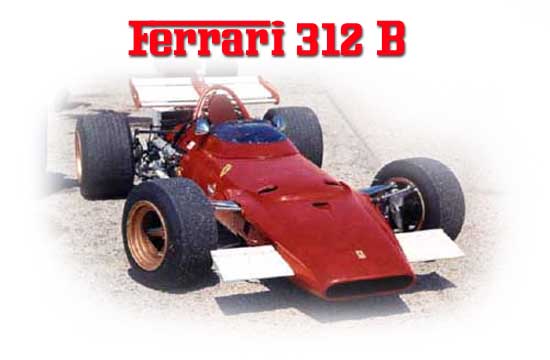
1970: It is with this very successful monoplace that Ferrari enters the era of 3 liters engines with 12 opposite cylinders (“B” meaning boxer). Ickx and Regazzoni dominates the second part of the World championship.
Ferrari opens the era of engines with 12 opposite cylinders of 3L with the 312 B, which makes its appearance in competition in 1970. This F1 will know an indisputable success, allowing Ickx and Regazzoni to dominate the second part of the World championship, gained however by Jochen Rindt and his Lotus. The Austrian driver will be regrettably victim of a fatal accident during the Italian GP practices at Monza, so becoming the first posthumously World champion of the Formula 1 history.
THREE VICTORIES FOR ICKX, ONE FOR REGAZZONI
In 1970, the 312 B brings three victories to Ickx, whereas Regazzoni has to content himself with the only one. It will also allow Mario Andretti to win the first Grand Prix of the 1971 season, at Kyalami, in South Africa. In the classification of the drivers world championship 1970, Ickx is classified second and Regazzoni third, whereas Ferrari appropriates the second place in the constructors championship.
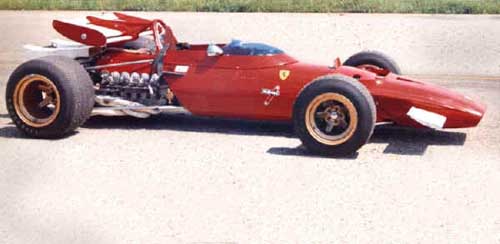
The 312 B had been finalized in the middle of year 1969 and should have made its debuts for the GP of Italy of the same season. But serious problems of engine, which annoyed considerably Chris Amon, then number 1 of the team, slowed down the program development of the monoplace, the career of which began only in the GP South Africa 1970. Meanwhile, Chris Amon had left Ferrari, demoralized by the inferior results and the deficiencies of 312 powered by the 12 cylinders in V at 180° engine. The elaboration of the 312 B turned around this new engine, work of the engineer Mauro Forghieri, which also took charge of the chassis.
THE “BOXER” ENGINE ALLOWS A BETTER ASSESSMENT OF THE WEIGHT
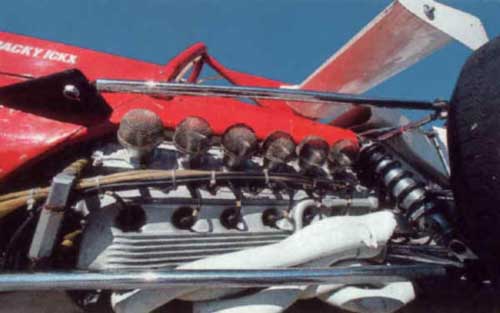
Even if the term is a little unfit, the engine was defined as a “boxer”, and the B of its naming indicated exactly this particular architecture. By its flat shape, the new 12 cylinders guaranteed a better assessment of the weight. Furthermore, it left free space in the superior zone, the air so meeting fewer obstacles when it streamed towards the wing. The real capacity of the engine was 2991,01 cc, with a very short stroke (51,5 mm) with regard to the boring (78,5 mm), so that the average speed of pistons is reduced there and so that the engine can thus reach a high speed of rotation. The power was 460 bhp at 11600 rpm.
TUBULAR STEEL FRAME, BODY IN PANELS OF ALUMINIUM
The meetering unit was composed by an indirect injection Lucas system, with ignition Marelli-Dinoplex. The distribution counted four valves by cylinder, was commanded by four head camshafts, two for every bloc of cylinders. The chassis of 312 B was realized by the system henceforth classic, which foresaw an armature in steel tubes covered with riveted panels. The structure went on over the driver’s shoulders and the engine was suspended down. This solution was introduced for the first time on the Honda RA 302 of 1968, equiped with an engine of 8 cylinders cooled by air. The rubber tanks were placed, as usual, laterally in the gap between the aluminium panels and guaranteed a total capacity of 240 l of fuel.
AN AERODYNAMICS OF AN EXTREME REFINEMENT
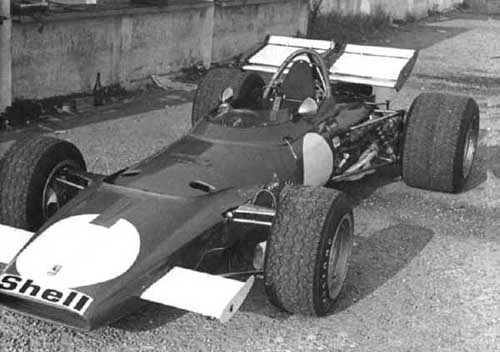
The fore air inlet, low and lengthened, and the cockpit dock gave a particular aspect to the set of single-seater. As it was previously said, the horizontal arrangement of the cylinders allowed to obtain a careened back section. Behind the helmet of the driver and the rollbar, the air could stream more freely towards the back wing composed of three blades. The rollbar was turned to the back, following the slope of the body curve, just behind the driver’s shoulders. On sides, the horizontal intake manifolds of the engine and the air intake pipes were perfectly visible and constituted so many distinguishing features of the 312 B. The suspension before was in superior pendulum with lower triangle, whereas the back suspension foresaw a geometry with superior arm and inverted lower triangle. Tyres, of brand Firestone, were of different sizes: 13 inches for the front and 15 inches for the back. Of very compact dimensions, the 312 B weighed 551 kg with water and oil on board. After one year spent with Brabham, the Belgian Jacky Ickx – income to Ferrari as driver number 1 – drove the 312 B during its debuts to the Grand Prix of South Africa 1970, which he concludes by a abandonment . The following GP, which ran at Jarama in Spain, was sharply more dramatic for Ickx: his Ferrari, collided by JACKIE OLIVIER’S BRM, had the disemboweled reservoirs and caught fire. Fortunately, Ickx took out with light burns there which did not prevent him from participating in the GP of Monaco, three weeks later, even if he was forced to abandon this time still. In Belgium, Ferrari added him the beginner Ignazio Giunti. The Roman driver signed for this occasion the fourth place more than flattering, so offering to the 312 B its first classification. Ickx arrived eighth. At Zandvoort, during the GP of Netherlands, Giunti gave up his single-seater to another beginner, Clay Regazzoni. The Swiss driver had pointed out in races of lower categories and Ferrari had decided to make him roam, in alternation with Giunti, for the GP of Formula 1. In the Netherlands, Ickx ended third and Regazzoni the fourth. By the fastest lap during the race of the Belgian driver, the remarkable possibilities of the 312 B were revealings.
THE FERRARI ENGINE WAS THE MOST POWERFUL OF ALL
The key point of the car was, unquestionably, its boxer engine, which quickly showed itself more powerful than the other 12 cylinders Matra and BRM and also, the Ford 8 cylinders which equipped, in the time, most of the cars engaged in Formula 1. On the occasion of the sixth race, the GP of France at Clermont-Ferrand, Ickx took place in pole position, leading the race during fourteen laps, before stopping because of a problem of distribution. From this moment, the Ferrari of the Belgian driver occupied the first line of the grid till the end of the season. Ickx obtained the pole position in Germany and in Italy, whereas Regazzoni was the fastest during the practice at Watkins Glen.
THE 312B SHOWED ITSELF FINALLY AS FAST AS THE LOTUS 72
At Hockenheim, Ickx and Regazzoni fought with Rindt for the victory. After the abandonment of Swiss, Ickx ended second. The 312 B was henceforth the single-seater the most competitive of the Championship with the Lotus 72. The Grand Prix of Austria, In Zeltweg, showed the victory, or better, a doubled ringing with Ickx and with Regazzoni, respectively first and second with a few meters between them. In Monza, the day after the death of Rindt, Clay Regazzoni gained, in the middle of a crowd in jubilation, his first Grand Prix on the the 312B, winning at the same moment a place of honor at Ferrari. The 312 B allowed Ickx and Regazzoni to finish first and second on two other occasions, in Canada and in Mexico. In the United States, Jacky Ickx was slowed down by problems of ignition, and he finishes fourth, not without being to grant himself the best lap of the race.
JOCHEN RINDT, WORLD CHAMPION POSTHUMOUSLY
Even if Jochen Rindt was crowned World champion posthumously after the Canadian Grand Prix, the 312 B had acquired the title of single-seater to be beaten at the end of season.
TECHNICAL DATA
Engine Central longitudinal 12 cylinders in V at 120° 4 head camshafts Bore x Stroke = 78,5 x 51,5 mm Capacity : 2991 cc Compression : 11,8:1 Distribution : 4 valves by cylinder Indirect injection Lucas Power : 460 bhp à 11600 rpm
Frame/Bodywork Monoplace with tubular frame and bodywork in aluminium Transmission : to back wheels – longitudinal gearbox with 5 gears + back gear ; differential auto-lock Suspension : Independent wheels with quadrangles Tyres : front = 13″ ; back = 15″ ; Firestone Brakes : disks auto cooled 4,02 x 0,742 x 0,956 m Track : front = 1,553 m ; back = 1,550 m weight : 551 kg Chassis numbers: 001-004 (the 002 destroyed at Jarama was reconstructed with the same number)| RESULTS OF THE 312B | ||
| 1970 | ||
| Belgian GP | June 7th | 4th Giunti, 8th Ickx |
| Dutch GP | June 21st | 3rd Ickx, 4th Regazzoni |
| British GP | July 18th | 4th Regazzoni |
| German GP | August 2nd | 2nd Ickx |
| Austrian GP | August 16th | 1st Ickx, 2nd Regazzoni |
| Italian GP | September 6th | 1st Regazzoni |
| Canadian GP | September 20th | 1st Ickx, 2nd Regazzoni |
| American GP | October 8th | 4th Ickx |
| Mexican GP | October 25th | 1st Ickx, 2nd Regazzoni |
| 1971 | ||
| South African GP | March 6th | 1st Andretti, 3rd Regazzoni |
| Spanish GP | April 18th | 2nd Ickx |