M2 – M3
1968-1969
The Mirage M1 and its big Ford engine being banished from circuits from 1968, the Gulf team, to support its GT 40, launched one 3 liters. Sub-motorized, this M2-BRM was of no help to John Wyer, but the M3-Cosworth finally booked a victory!
ONE DOUBLE THE BET !
When, in August 1967, thus less than six months before the first race (24 H of Daytona) of the new World Championship of the Marks, the International Sports Commission, the ancestor of the FISA, decided, ex-abrupto, to upset its own laws, whatever are the particular interests of the concerned constructors, it was everywhere a general outcry. Without speaking about Grand Tourism’s cars (500 cars produced and unlimited capacity), by officializing the existence of two new categories – ” Sport Prototype “, up to 3 liters and “Sport”, 50 (then soon 25) cars produced and maximum capacity fixed to 5 liters – The C.S.I. already established a segregation, denounced immediately by Enzo Ferrari, but which effects nobody exactly could foresee then exactly. And there was worse. Because, by throwing away – in the name of the safety – the Ford MK IV or the other big US engines, by cutting the wings of Chaparral or by sending Ferrari P4 to the museum, the responsibles (?), impoverishing certainly the future spectacles, could only discourage the marks event the wilfulness ones.
Among these more or less startled constructors, John Wyer and his friends from Gulf, although they also have and as everybody rebelled, benefited all the same from a position to part, otherwise privileged. Certainly, it was not probable that the Mirage M1 used in 1967 can be ever built in enough number for applying a ratification in “Sport 5 liters” but at Slough they had the possibility to use the Ford GT 40, these cars in which John Wyer, the more and the better that quite other, believed. Although the new Gurney-Weslake cylinder heads were approved soon enough – that they had to be, moreover, for the surprise of someone! – lightened GT 40, well prepared, always could, in version 4,9 liters (more than 400 ch), defend itself, especially on the long races, like Daytona, Sebring and, naturally, Le Mans.
However, as to command it is to foresee, it was necessary to count with the ageing of a model of which the first drawings went back up to winter 1963-64. And how, at this beginning of year 1968, nobody could seriously imagine that a builder (and all the more two) would be one day rather confident, rather rich or rather crazy to scoff at the spirit of the laws by building – for legal ratification – 25 Sports-prototypes with 5 liters engine, better was worth preparing the future by doubling the bet! Especially with the aim of the short races of 1000 km, a true Sport-Proto model that is a power-driven car 3 liters, was thus desirable. Conceived, builded and running in 1968, it could be operational for the 1969 Championship.
THE VETO FROM M. HAYES
To design this new Mirage which would take, simply, the reference M2-300, Len Bailey’s name, with whom John Wyer had already worked at Ford’s, seemed to be imperative. Regrettably, it is exactly these links with Ford which made collapse at once any hope of collaboration. Charged by Ford, through Walter Hayes, the founder of the DFV Cosworth, to build a “Sport-prototype” for the Alan Mann team, Bailey – and Hayes was moreover determinedly set against it – could not logically auto-compete. John Wyer asked then Eric Broadley, father of this beautiful GT which, in 1963, had given the ideas to people from Ford. Free for a long time of any foreign links, Broadley was ready to say yes, if the new Mirage would be called Lola! And that’s why an agreement was finally signed with Len Terry who, among others success, had worked with and for Colin Chapman and participated confidentially in the American success of the Lotus-Ford type 8.
Terry set to work after they were able to – the other delicate job – found an engine. Even there Wyer had thought about the very young Ford Cosworth V8 3 liters which, at first delivered exclusively to the Lotus F1 team, normally had to fall in the public domain from January 1st, 1968. The affair, there also, failed; the Bailey-Alan Mann – aka W.Hayes – having priority! Moreover, even though John Wyer would have managed to convince Hayes, Keith Duckworth, very sought by the F1 teams, would not maybe have been able to insure the delivery and the maintenance, for the required period. After having hesitated for the V12 Weslake, relatively powerful but renowned fragile, then for V8 Repco – the world champion 1966-67 of new F1 – sturdy (at least in its first versions) but limited to 325 hp, they opted for the V12 BRM. Because of the 375 announced HP and with the hope to get soon the V12-48 valves exceeding the 420 HP, it was to be possible to make good results, although the new car is held in the weighty limits ( minimum 750 kg) required.
WEIGHTS AND MEASURES
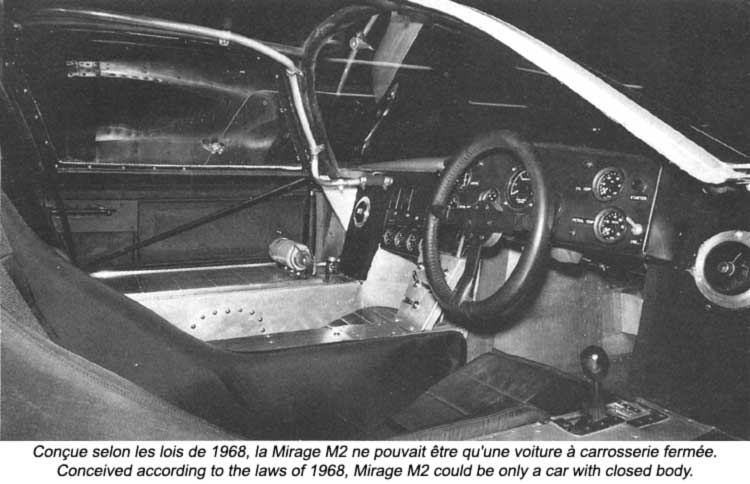 Tightened by a regulation which still imposed, in 1968, very strict quotations in matter of windscreen and protected height, Terry, Wyer and Horsman had naturally opted for the principle of a car with closed body. It was obviously difficult to them to foresee the future and new about-turn of the C.S.I. which, from 1969, would abolish – among others – the big windscreens. Naturally, beside the colours, this M2, had nothing similar with the Mirage M1, if it is not maybe in the “lapel” of its back part. The curve of the stern cut moreover sharply with the very jagged lines of sides, this profile being still amplified by a pinching out called to disappear on the cars which would been see in the 1000 km of Nürburgring.
For the structure, Terry had conceived a frame hull in light alloy, positioned radiators on the sides and realized the suspensions by superposed triangles for the front and lower parallel arms (Cf. BRM F1 signed Terry) on the back. With a base (240 cm) reduce of 1,3 cm compared with the GT 40, the car was less long (421,6 against 426,7 cm), less wide (191,8 cm against 193,1 cm) and also less high (94 against 101 cm) than its elder sister. The disc brakes supplied by Girling were all placed in the wheels. As for the weight, declared 750 kg seemed about so optimistic as 375 HP of V12 BRM, coupled with a gearbox ZF 5 DS25.
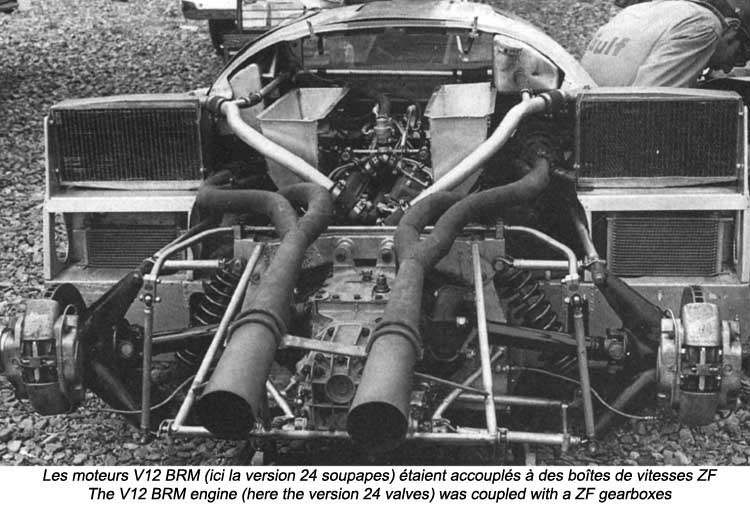 Naturally, after all the initials negotiations (engineer, engine, etc.), the schedule which foresaw a first official release of the M2 on August 25th, 1968 at Zeltweg, was not able to be respected and it is three days before the Austrian race that the M2-300-001 made its first turns of wheels on the circuit of Silverstone. An overheating of the BRM shortened this simple test, but at Snetterton, a week later, by going out of the track, rather violently, Robin Widdows obliged the team Wyer to put back his hopes on the 1969 season. In mid-December, Jacky Ickx, at Silverstone, took the steering wheel of from a reconstructed car, but he did not get an immortal memory of this test. As it was more cold than in August, the BRM warmed less, but it missed manifestly power. Having said that, the M2 had run fast enough so that all: drivers, designers, assistants, noticed that it sub-turned horribly, that in a straight line its holding of cap (very faint steering) was rather unpredictable, in other words that it was still far from its optimal shape. To hasten the movement, John Wyer who had engaged two GT 40 within the 24 hours of Daytona, scheduled on February 1st and 2nd, 1969, arrived a little earlier than foresaw in Florida with in its luggage the M2.
In private tests, the Mirage-BRM turned during at least 7 hours without being able to come down – with Hobbs at the steering wheel – below the 1’56″8. Compared with the times of the GT 40 of the team (1’54″5 for Ickx-Oliver, 1’55″3 for Hobbs-Hailwood) this lap time, realized with bad gear set and too small wheels, was not completely disastrous, but it was necessary to note that Siffert-Redman, a Porsche 908 with a 3 liters engine was going to make the Pole Position in 1’52″2! Wisely, the M2 was not engaged and it is finally the big Lola T 70 – thus a Sport with a Chevrolet 5 l engine – of Donohue-Parsons who, little in the wear, won the race. The GT 40 Gulf had disappeared, but with Ickx-Oliver, the orange and blue team taken its revenge at the 12 H of Sebring, where the M2 did not still appear. For Wyer, this move to Sebring had been finally beneficial twice because, besides the victory, he was contacted for the first time by Rico Steinemann, the emissary of Ferry Porsche.
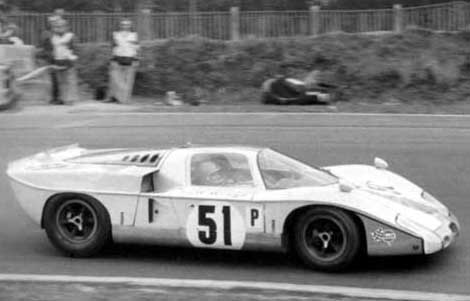
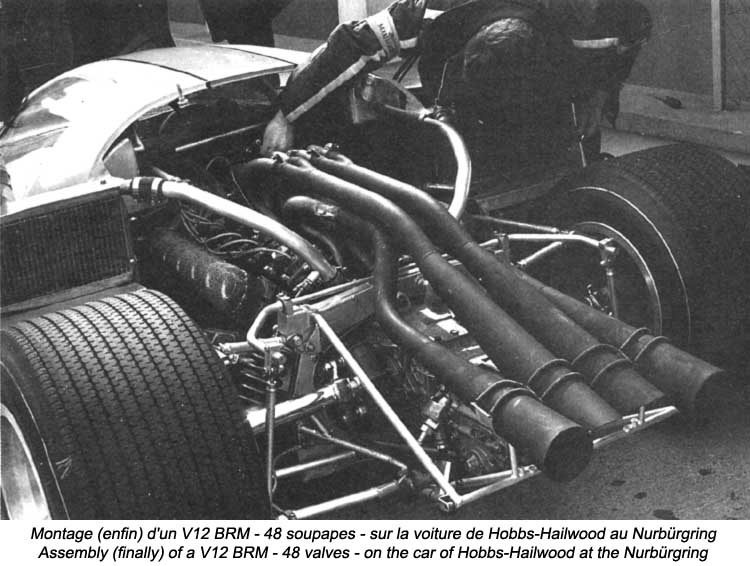 It is thus, at Brands Hatch, 3rd heat of the World championship, not too far from its home, that began the 3 liters, the GT 40 of Hobbs-Hailwood being engaged in coverage.
The precaution showed itself sensible because the Ford – 5th in scratch – was led in “Sport” and consoled the team of the setbacks and the incapacities of the M2. Faster than the GT 40, but very sharply dominated during the practices by the Porsche 908 (Siffert: 1’28″8), by new Ferrari 312 (Amon: 1’30″0), by four Lola Sport and even by the Ford P68 Alan Mann of Hulme-Gregory, the Mirage in spite of all the efforts of Ickx (11th time in 1’35″4) was also disappointing during the race. It granted regularly two laps per hour to the leaders when, after already an alert with the suspension, the transmission broke.
At Gulf, they react and to give themself the time to work and to finish the second car engaged at Spa, the team – the GT 40 included – did not made to Monza nor the Targa. While by modifying the exhausts (Gulf fashion, with 2 exits, Weslake fashion with 4) the motoristes tried to shake the apathy of the BRM, after comparative tests led at Thruxton, the suspensions (drawings but also springs, rollbars, etc.) were modified too. And in Belgium, although any comparison established here is falsified by Ickx, “Jacky-jockey-joker”, the M2, in 3’46″6, took finally a place in first line. He was flanked by the Lola Sport of Paul Hawkins (P.P. in 3’42″5) and by Joseph Siffert who, in spite of a incredible time (and acrobatic) in 3’41″9, at the wheel of the first Porsche 917, had finally preferred to content himself of the 3’48″6 of his 908.
WHEN PORSCHE FALSIFY THE GAME
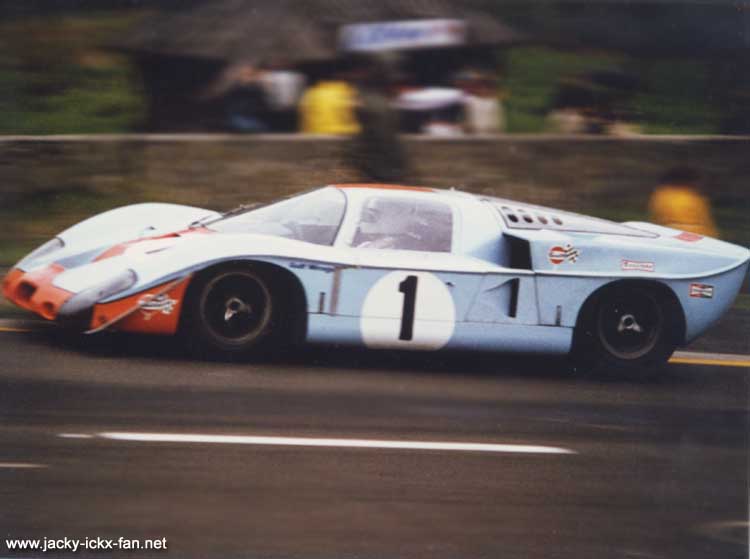
What nobody could imagine, Porsche had thus tempted it. Since April 25th, more twenty five “917 Sport” 12 cylinders 4,5 liters were very regularly approved. The CSI looked stupid and as one expected a retort of Ferrari, the future of Sport-Proto 3 liters seemed suddenly very narrow-minded.
At Spa, nevertheless, these considerations more or less futuristic did not worried the Gulf team, too much occupied with knowing how long Jacky Ickx could stay on the track. Heroically, the young Belgian champion navigated at the 5th rank when, in the 11th lap, a breakdown of the fuel asembly stopped him towards Stavelot. In the recollection of the granted risks, it is maybe this day when one attributed it the word ” Mirage BRM? It is a car… Terryfic! “. As for the other M2, it managed to end, but at 6 laps and on 11 cylinders!
This time, John Wyer was close to lose his legendary phlegm. The delivery of the BRM 48 valves being regularly adjourned, he obtained that they lend him at least one of these engines for the 1000 km of the Nürburgring. At Bourne, they accepted, but right after mouting in the car affected (frame 02) to Hobbs-Hailwood, the 450 HP claimed seemed suddenly very light. It was difficult to judge, because after a beginning of fire during the prctices, Hailwood, besides victim of a spin, had to retired on lack of petrol! Wyer hurried to return the BRM, but kept on the other hand, the V8 Ford Cosworth which equipped the car of Ickx-Oliver! One had thus given in at Ford’s? Doubtless, although since the refusal formulated in 1968, many things had evolved. The unhoped world title, picked up in 1968 by the GT 40, Heyes knew to whom he owed it and as the operation Bailey-Alan Mann, at first with closed P68, then with spyder P69, was definitively abandoned, the time seemed to arrive to manage to make a gesture. At Slough, the loan of two engines of the series 9 was enough to restore an unhoped boost. Too wide for the original frame of the M2, the Cosworth requiring numerous reorganizations, the affair had roundly been led. One built tubular extention to the hull, ways were a little widened and the slightly redrawn back bonnet. With, finally, more than 400 HP, they could again fight.
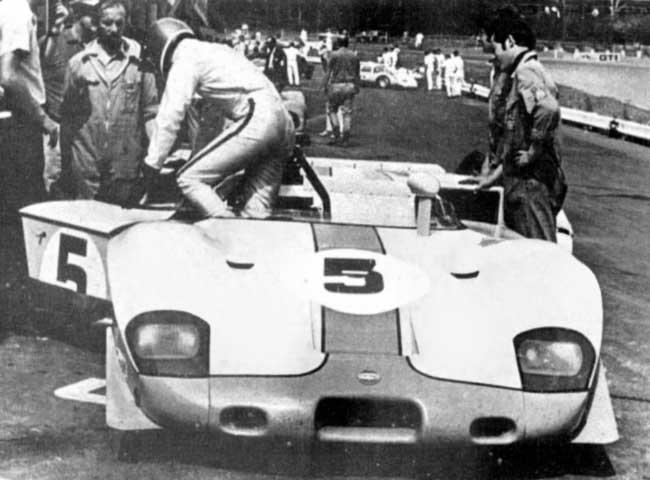
What neither Wyer, nor Horsman, nor Yorke had completely foreseen, it is that the power of Cosworth was going to show a little more the defects of their car, notably about the road holding. And as the German circuit was always mercilessly, Ickx and Oliver were going to suffer again a lot. Beside the clutch and even the gearbox (Hewland) troubles met during the practice sessions; and in spite of all his knowledge of circuit, Ickx, in 8’24″1, started far from Siffert (8’00″2 on the 908) and also Chris Amon (8’00″3 on the Ferrari 312 P). During the race, in spite of a beautiful start, any new expectations were still pushed away when, in the 19th lap, suspension broken Oliver stopped on three wheels in the bend of Karussel. Fortunately, 15 days later, the historic victory taken in the Sarthe by Ickx-Oliver and the indefatigable Ford GT 40, was widely enough to dope a team which, at Watkins Glen, on July 14th, presented a new car. It was in fact an M2 spyder, but in the widened ways and especially lightened by at least 40 kg. Was not the commitment of this M3 or M2Bis premature? One could believe it, because a vice of suspension, discovered 20 minutes before the start, condemned once again Jacky Ickx to play the kamikazes. Disordered, the car “ate” abnormally its tires, the steering floated, but it is finally the Cosworth that, in the 113th lap, abbreviated the agony of the newborn spyder.
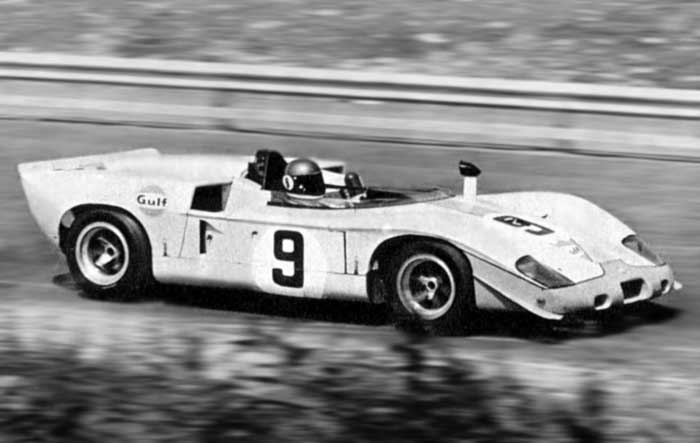
Decided to prove that with a good engine, a Mirage could finally amaze, John Wyer, having still worked again his frame (strengthened suspensions, V8 mounted lower, etc.) landed at Zeltweg. A ring of fixation of the steering badly welded was regrettably enough so that Ickx, Pole position and lap record in pocket, cannot prevent the Porsche 917 of Siffert-Ahrens from celebrating its very first laurels. Encouraged by this missed exploit, all the Gulf team went in September 14th to Imola. The race did not count for the Championship. Foreseen on 100 laps (500 km) it was shortened by the rain during the 71th lap, but it is very easily that Ickx, this time, outstripped the Alfa 33 of Giunti, the Abarth 2000 of Merzario, Van Lennep, Hezemans and the usual field of Porsche 907 and 906.
THE HOPE CHASES AWAY THE REGRETS
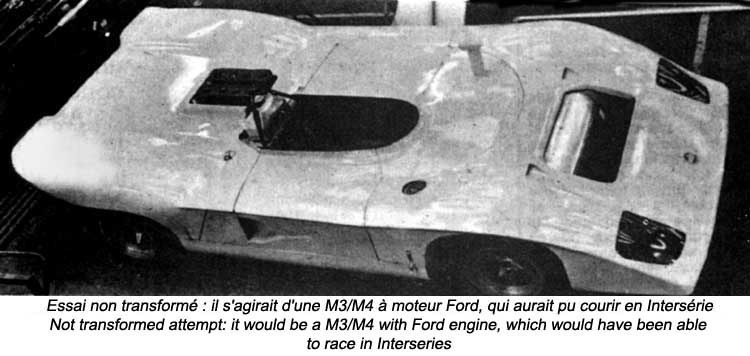 This first, unique and small victory had to coincide with the ultimate release of the M3. Worked again during winter, this still refined spyder (main radiator transferred in front, cut back wings, etc.) and equipped with big V8 Ford of 5,7 liters, was photographed at Slough some years ago, by reporters of Motoring New. But in our knowledge, it never ran. This M4 thus has to survive still with the M2-BRM (frame 002) which, acquired at first by Jo Siffert was, after a tour in the USA, bought back by the British Chris Stewart. The frame was carefully revised and at BRM, they tried to restore a little of tonus in the BRM (still 24 valves). It is this model which was tried at Silverstone in 1979 by Michaël Bowler for the review Classic Cars.
What to deduct then from the second adventure Mirage of the years 1968-69? To consider the performances accomplished at Zeltweg, then at Imola, it is allowed to think that Wyer-Gulf and Terry were doubtless the direct victims of Ford’s prevarications, but especially of the official inconsequences. Indeed if, from 1968, it had been allowed them to conceive at first a spyder of the kind M3 and not the heavy M2, the face of the (small) world (of race) had been there – who knows? – changed! But during winter 1969-70, the time at Gulf, was not any more for the regrets. A new hope announced. It had, still, 12 cylinders, but it was a Porsche this time!
Christian MOITY