
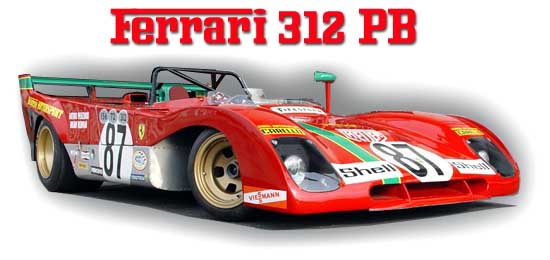
When the FIA (Federation International Automobile) dramatically changed the regulations for sports car racing at the end of 1967, Ferrari’s entire fleet of sports prototypes were left obsolete. In an attempt to get on top in Formula 1 again, Ferrari decided to abandon sports car racing and completely focus on open wheel racing for at least a year. Disappointing Formula 1 results in the 1968 season saw the Scuderia return to prototype racing, trailing a year in terms of development time.
Two types of racers were eligible to compete under the new regulations; 3 litre prototypes or 5 litre sports cars, which needed minimum production of 25 cars to be homologated. Ferrari already had experience in Formula 1 with racing 3-litre engines, so it came as no surprise that when they announced their return to sports car racing, a new 3 litre prototype, the 312 P, was unveiled. After only half a season it was abandoned with the works team focusing on the construction of the 5 litre 512 S, which was to be pitched against the Porsche 917 first seen at Le Mans in 1969.
A year after the 917, the Ferrari 512 S made its debut. It was immediately running quick laps, but being a year behind the 917 in development, it was beaten on reliability. For the second time in two years Ferrari cut a development program short and started work on yet another racer. With most of the 512s sold to privateers, it was time to produce another three litre prototype. It would be based on the brand new 180 degree V12 engine, which made its debut in the 1970 312 B Formula 1 racer. This Mauro Forghieri designed engine would become one of the most successful engines of the 1970s.
Outwardly similar to a boxer engine, the Forghieri was a flat V-engine. The difference between a boxer and a flat V engine is the shape of the crank and the ignition sequence; a boxer engine’s opposing pistons move towards each other whereas a V engine’s pistons move in unison. The big advantage over the 60 degree V12 engine used in the previous 312 P was the low height of the 180 degree engine. This helped to decrease the car’s overall height and to lower the centre of gravity, which helped handling.
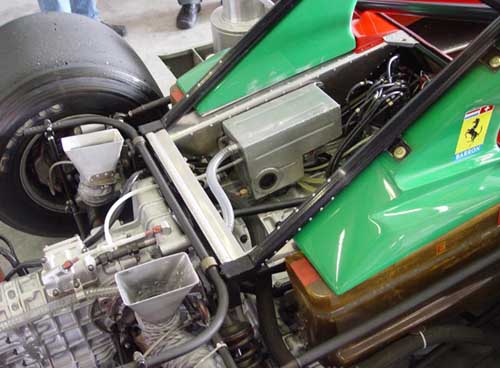
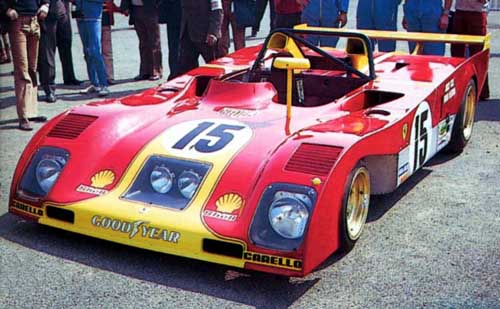
Although technically it was not a boxer engine, cars powered by Forghieri’s V12 were often given the abbreviation ‘B’. Such, however, was not the case with the 312 P of 1971, but it is now commonly known as 312 PB, which also helps to distinguish it from the 312 P of 1969. Like its Formula 1 counterpart, the 312 PB featured an aluminum semi-monocoque. The engine and rear suspension were attached to a steel frame which was bolted on the aluminum tub. The 312 PB was basically a Formula one racer with a full width body.
One of the main reasons behind the 312 PB project was the FIA’s decision to abandon the 5 litre sports car class and allow only the 3 litre prototypes to run in the World Sports car Championship as of 1972. The 1971 season could be used as a learning year, which meant that Ferrari wasn’t a year behind for once. The ‘PB’ made its debut in the 1971 April Brands Hatch 1000 Km race, it immediately showed potential and finished 2nd behind an Alfa Romeo Tipo 33/3. In the remainder of the season, no noteworthy results were achieved by the ‘PB’.
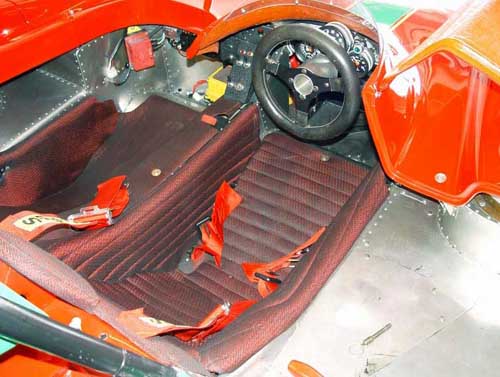
Over the winter, the ‘PB’ was further modified. The performance of the engine was increased from an output of 450 bhp to 460 bhp. Various body styles were also tested, with special attention paid to the rear aerodynamics. For the 1972 season, the best drivers were hired to make sure Ferrari won the manufacturer’s championship. These included Jacky Ickx, Brian Redman, Arthuro Merzario, Tim Schenken, Mario Andretti and Ronny Peterson.
Round one of the championship was the Buenos Aires 1000Km race, where the ‘PB’ took its maiden World Championship victory in the hands of Schenken and Peterson. All other championship races of the season were subsequently won, with exception of the 24 Hours of Le Mans. No ‘PBs’ were entered at Le Mans, as it was considered by the works team as a 1000 Km racer and not a 24 hour endurance racer. The Scuderia saw no need to enter it, fearing it would not complete the full distance. Only eight of the ten races counted towards the championship so the absence at Le Mans did not affect their standings. Ferrari won outright with 160 points, Alfa Romeo was a distant second with 85 points.
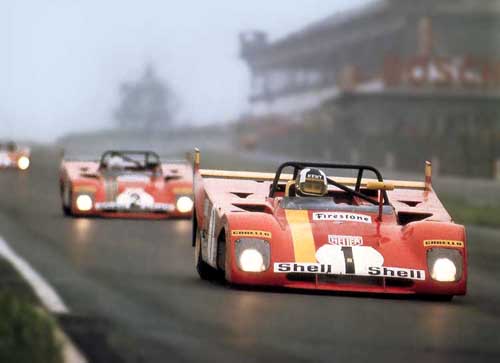
In 1973 Ferrari constructed a 12cm longer wheelbase version of the ‘PB’. It also featured a further revised engine, which was now good for 475 bhp. Unfortunately for Ferrari, the rock-solid reliability record of 1972 was rarely matched in ’73. The ‘PB’ shined only once, at the 1000 Km of Monza race in April. One car finished at Le Mans, but a distant second behind the Pescarolo/Hill driven Matra. In the championship the Scuderia was also beaten by Matra, by 9 points. Ferrari retired from sports car racing entirely after the 1973 season, making the 312 PB the final chapter in Ferrari’s very successful sports car history.
TECHNICAL DATA
Engine
Mid, longitudinally mounted
Type 623/001 180º V12
Valvetrain : 4 valves/cylinder, DOHC
Displacement : 2.991 liter / 182.5 cu in
Fuel feed : Lucas Fuel injection
Power : 460 bhp / 343.2 kW @ 10800 rpm
Frame/Bodywork
Monoplace with tubular frame and bodywork in aluminium
Transmission : to back wheels – longitudinal gearbox with 5 gears + rear gear ; differential auto-lock
weight : 665 kg / 1466.1 lbs
Numbers built: 12