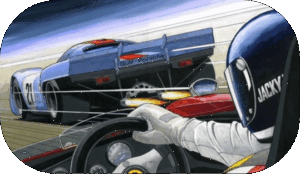
In the late 50’s Ford was a company in search of an image and finally decided that motorsport succes would be the best image builder.
Early in 1963 Henry Ford went to the Daytona 24h race to see the Ford financed Cobra tounce the opposition. They hadn’t done so to his consternation; Ferrari got in the way. The leadership at Ford reasoned the easiest way to win races was to buy a company that was already winning, like Ferrari. Ford made an offer to Enzo Ferrari. The deal was Ford would take over the manufacturing of the production cars, Enzo would continue to run the racing operation. Enzo dragged his feet asking for more time to think about it. He came back to Ford with some conditions for the deal. One was that Ford would stop offering support to that upstart Carroll Shelby. But by this time Ford was having second thoughts too. The deal to buy out Ferrari fell through, besides even if a Ferrari carried a Ford flag, it wouldn’t quite have been the same as a Ford winning. After all, Carroll Shelby’s Cobras were winning races in the early 60’s but the Cobras were hybrids, not true Fords. The engines may have been Ford but the body was English. The leadership at Ford wanted a Ford to win races.
When the subsequent serious negotians failed. Ford tried a different strategy to increase its youth appeal. They wanted to beat Ferrari in the race Ferrari dominated at that time, Le Mans. Ford Advanced Vehicles was created. A team was sent to Le Mans in 1963 to witness the race and view the competition. That team included Carroll Shelby. Ferrari took the first 6 places, a Shelby American Cobra placed 7th and an independent Cobra completed half the race.
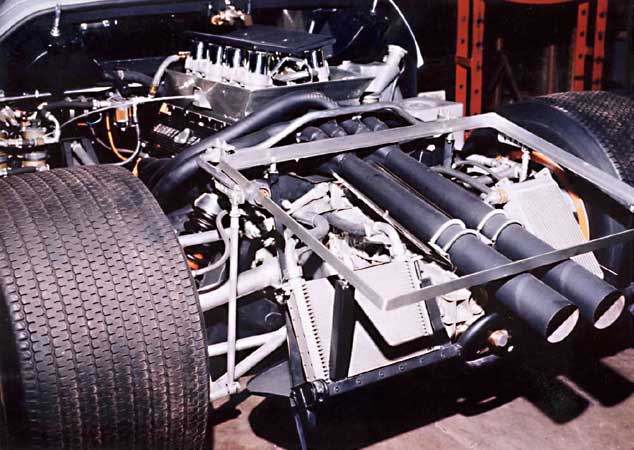
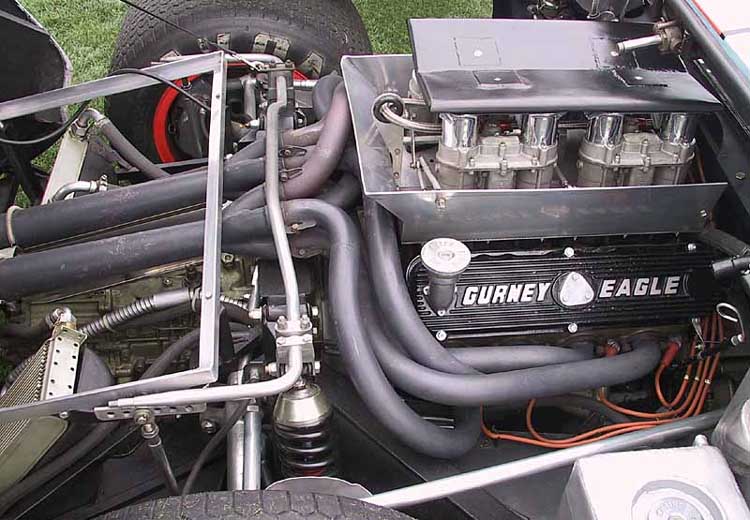
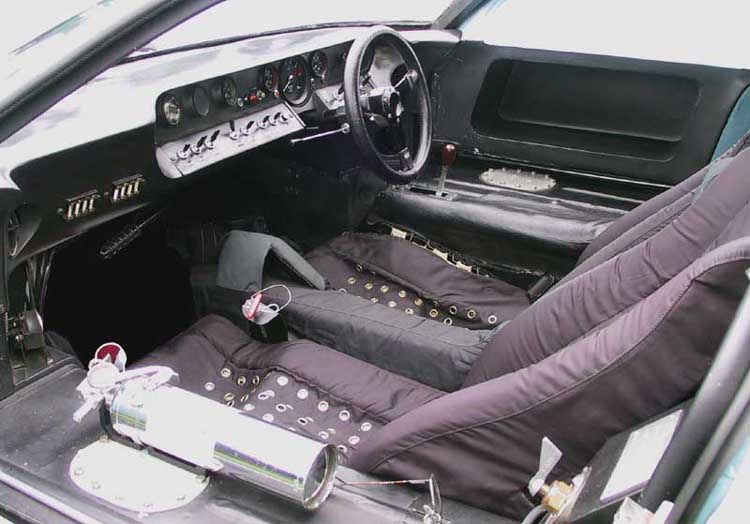
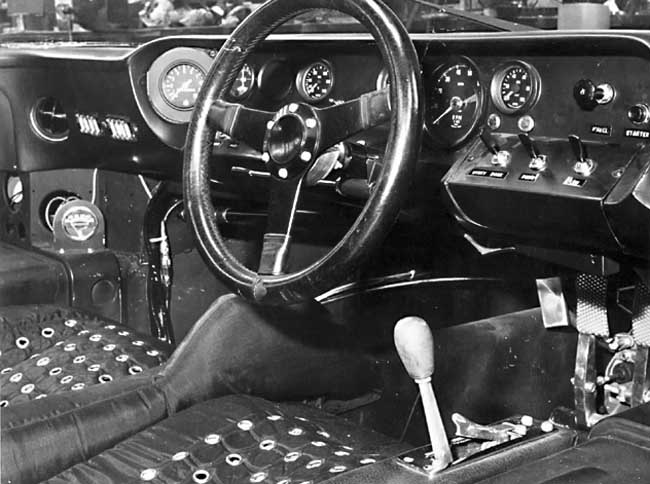
The next project was to find a body. These were the days before computerized design wind tunnels. At a car show in England, an Englishman named Eric Broadley displayed a Ford powered body he called the Lola GT. The body was very aerodynamic, the roof was only 42″ off the ground. The construction was very unique for a race car, it was a unibody. The car did not have a frame as other cars did. The body was one piece forming the frame of the car, thus the term uni-body was used. Broadley signed a two-year contract with Ford. John Wyer, an Englishman, was named team manager. (Wyer was in charge of the Aston Martin team that Carroll Shelby had won the 1959 Le Mans with.) Shelby was brought in to run the project PR, race the GT40 in the US and market the street version. Broadley’s design was put to wind tunnel tests at the University of Maryland. Ford engineers redesigned the body to fit the chassis dimensions. The interior had flow-through ventilation designed by Ford to cool the interior. An aluminum 4.2 liter F.A.V. (256 CID) Fairlane V-8 powered the GT40. With four Weber carbs, the engine put out over 350 horsepower. A 4-speed trans-axle (Colotti type 37) put the power to the wheels. This was the only one of its kind available.
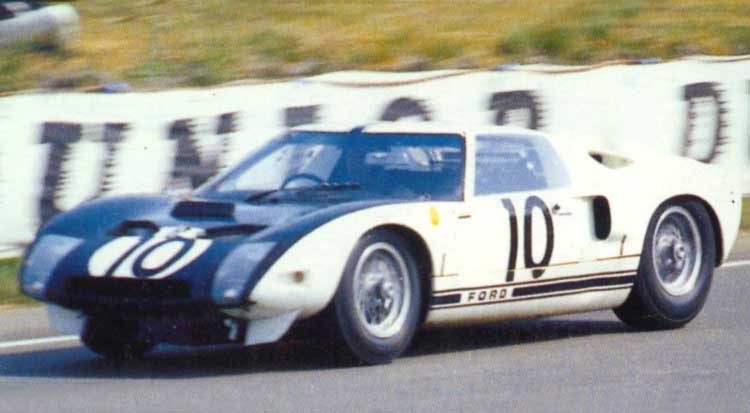 Ten months later, two GT40 were shipped to Nurburging for their first race. But their target was the 24 Hours of Le Mans in April. Three GT40 were prepared for Le Mans. The GT40 were far from successful. Early in the race there was little doubt the GT40 were the fastest cars on the track. The Ginther/Gregory GT40 lasted six hours before the transmission took it out of the race. The Collotti 4-speed was plagued with problems. The engines weren’t reliable either. During the 1964 season the GT40 had 10 starts and 10 DNFs (Did Not Finish). The team was demoralized. Broadley quit. At the 1964 Nassau Speed Week, the last time a Ford team raced the two GT40, both cars had suspension failures. They were poorly prepped, primarily due to lack of enthusiasm. The car driven by Bruce McLaren lasted three laps of the preliminary Tourist Trophy race and was parked. The Phil Hill GT40 did better. It came in third in the preliminary race and went out in the 17th lap of the next race. Neither car was entered in the main race, the Governor’s Cup.
The GT40 proved they could win. On the track, they were awesome. But winning races meant finishing them. An experienced hand was needed. Carroll Shelby and his Shelby American team were the logical choice to take over the project. Besides, Shelby American Cobras were winning the races over the GT40. The two cars were shipped by TWA air freighter as is from Nassau to Los Angeles, California, in December 1964. The first thing Shelby did was make Carroll Smith Team Manager. He recruited Shelby American chief engineer Phil Remington and driver Ken Miles to help work the problems out of the cars. John Wyer continued at Ford Advanced Vehicles assembling the cars from sub-contracted parts. The cars had to be race ready for Daytona in eight weeks. After the cars were cleaned up, given a paint job and the engines replaced, Ken Miles and Bob Bondurant test drove them at Riverside track. The cars had both understeer and oversteer. The narrow tires on the wire rims caused the car to slide around a lot. Ken Miles told Carroll Smith the GT40 handled so terribly he wouldn’t drive it again until problems were fixed.
The GT40 couldn’t win as they were. The exotic Indy F.A.V. (Fairlane) 4.2 liter block had to go. It was replaced with the race proven 289. So went the dry oil sump system replaced with a wet sump also saving 50 lbs. The Colotti transaxle had to be modified until new ZF transaxles arrived. It hadn’t lasted more than six hours in any one race. A Ford engineer fashioned a hardened ring and pinion gear to replace the unreliable stock ones. The poor aerodynamics were altered. The cooling system was enlarged. Oil and transmission cooling were improved. Much larger disc brakes went on the front. One of the most key change was replacing the heavy wire wheels and narrow tires with Halibrand magnesium wheels with wide Goodyear tires. Not only did that switch save 30 lbs., the GT40 handled remarkably better. The cars were painted Shelby American colors – twin white stripes on a medium blue body.
Development continued right up to the Daytona Continental 2,000 Km Race. The cars were continuously tested and changed. At Daytona, front and rear spoilers were added after it was discovered that they were unstable at high speed during banking. The GT40 driven by Ken Miles and Lloyd Ruby won the Daytona Continental race. Leo Beebe and Ray Geddes of Ford were there to witness it. In eight weeks, the Shelby team had converted a losing car to a winner and on their first time out.
Shelby’s GT40 team won the first two races of the 1965 season, Daytona and Sebring. The next three races, Monza, Targa and Nurburging were disappointing at best. But while the GT40 were being prepped, Ferrari and the competition were also gearing up for the upcoming confrontation. More horsepower was needed for the GT40 so Shelby’s team modified a Mk I to accommodate the 7 liter 427 CID. The small block would power the GT40 to 200 MPH. But the 500 HP 427 topped 210 mph the first time out with Ken Miles at the wheel. Called Mk IIs, the big block GT40 were plagued with aerodynamics and high speed handling problems.
Ten months later, two GT40 were shipped to Nurburging for their first race. But their target was the 24 Hours of Le Mans in April. Three GT40 were prepared for Le Mans. The GT40 were far from successful. Early in the race there was little doubt the GT40 were the fastest cars on the track. The Ginther/Gregory GT40 lasted six hours before the transmission took it out of the race. The Collotti 4-speed was plagued with problems. The engines weren’t reliable either. During the 1964 season the GT40 had 10 starts and 10 DNFs (Did Not Finish). The team was demoralized. Broadley quit. At the 1964 Nassau Speed Week, the last time a Ford team raced the two GT40, both cars had suspension failures. They were poorly prepped, primarily due to lack of enthusiasm. The car driven by Bruce McLaren lasted three laps of the preliminary Tourist Trophy race and was parked. The Phil Hill GT40 did better. It came in third in the preliminary race and went out in the 17th lap of the next race. Neither car was entered in the main race, the Governor’s Cup.
The GT40 proved they could win. On the track, they were awesome. But winning races meant finishing them. An experienced hand was needed. Carroll Shelby and his Shelby American team were the logical choice to take over the project. Besides, Shelby American Cobras were winning the races over the GT40. The two cars were shipped by TWA air freighter as is from Nassau to Los Angeles, California, in December 1964. The first thing Shelby did was make Carroll Smith Team Manager. He recruited Shelby American chief engineer Phil Remington and driver Ken Miles to help work the problems out of the cars. John Wyer continued at Ford Advanced Vehicles assembling the cars from sub-contracted parts. The cars had to be race ready for Daytona in eight weeks. After the cars were cleaned up, given a paint job and the engines replaced, Ken Miles and Bob Bondurant test drove them at Riverside track. The cars had both understeer and oversteer. The narrow tires on the wire rims caused the car to slide around a lot. Ken Miles told Carroll Smith the GT40 handled so terribly he wouldn’t drive it again until problems were fixed.
The GT40 couldn’t win as they were. The exotic Indy F.A.V. (Fairlane) 4.2 liter block had to go. It was replaced with the race proven 289. So went the dry oil sump system replaced with a wet sump also saving 50 lbs. The Colotti transaxle had to be modified until new ZF transaxles arrived. It hadn’t lasted more than six hours in any one race. A Ford engineer fashioned a hardened ring and pinion gear to replace the unreliable stock ones. The poor aerodynamics were altered. The cooling system was enlarged. Oil and transmission cooling were improved. Much larger disc brakes went on the front. One of the most key change was replacing the heavy wire wheels and narrow tires with Halibrand magnesium wheels with wide Goodyear tires. Not only did that switch save 30 lbs., the GT40 handled remarkably better. The cars were painted Shelby American colors – twin white stripes on a medium blue body.
Development continued right up to the Daytona Continental 2,000 Km Race. The cars were continuously tested and changed. At Daytona, front and rear spoilers were added after it was discovered that they were unstable at high speed during banking. The GT40 driven by Ken Miles and Lloyd Ruby won the Daytona Continental race. Leo Beebe and Ray Geddes of Ford were there to witness it. In eight weeks, the Shelby team had converted a losing car to a winner and on their first time out.
Shelby’s GT40 team won the first two races of the 1965 season, Daytona and Sebring. The next three races, Monza, Targa and Nurburging were disappointing at best. But while the GT40 were being prepped, Ferrari and the competition were also gearing up for the upcoming confrontation. More horsepower was needed for the GT40 so Shelby’s team modified a Mk I to accommodate the 7 liter 427 CID. The small block would power the GT40 to 200 MPH. But the 500 HP 427 topped 210 mph the first time out with Ken Miles at the wheel. Called Mk IIs, the big block GT40 were plagued with aerodynamics and high speed handling problems.
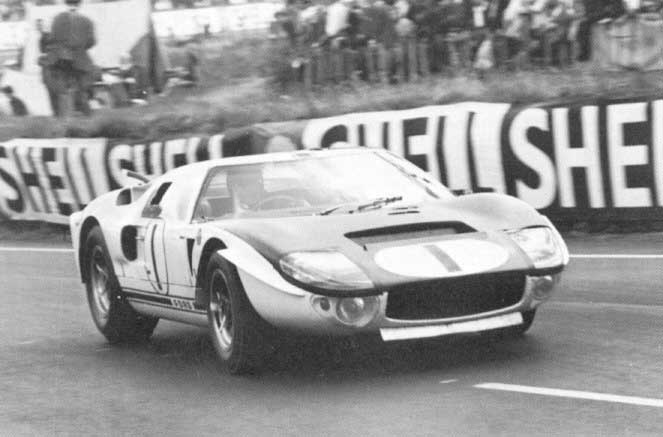 At Le Mans in 1965 the GT40 ran off with the race only to succumb one at a time to problems with the new Kar Kraft 5 speed transaxles. The small block GT40 had gearbox and cylinder head problems. All dropped out of the race. Ford once again pulled out of European racing for the rest of the `65 season.
Ford regrouped by the 1966 racing season and was even more determined to win in Europe. The big block was definitely the way to do it. A decision was made to enter three teams, under the assumption that three cars were the most any one team could handle successfully. In addition to Shelby American, Ford enlisted the help of big block stock car winners, Holman and Moody, and Alan Mann. Ford’s Kar Kraft tested all the 427 engines and drive trains for reliability.
A Mk II GT40 was converted to an open roadster. It was given to Bruce McLaren for further development. The 427 powered car was entered in the 1966 Sebring race and Ken Miles drove it to first place. An interesting story is told about Dan Gurney in that race. Gurney had qualified for pole position in a Mk II. At the start of the race, Gurney was the first one to sprint to his car, only to find his GT40 wouldn’t start. The rest of the 64 cars had gotten away and were out of sight before he got the big block started. By lap 10, Gurney had passed 54 cars to take 10th place. By the first hour he had set a new lap record and moved past Ken Miles to lead the race. Gurney and co-driver Grant held 1st place until the very last lap. Only 1/4 mile from the finish the GT40 quit! Gurney got out and pushed the car across the line only to be disqualified. If he had stayed in the car, he would’ve gotten 2nd.
At Le Mans in 1965 the GT40 ran off with the race only to succumb one at a time to problems with the new Kar Kraft 5 speed transaxles. The small block GT40 had gearbox and cylinder head problems. All dropped out of the race. Ford once again pulled out of European racing for the rest of the `65 season.
Ford regrouped by the 1966 racing season and was even more determined to win in Europe. The big block was definitely the way to do it. A decision was made to enter three teams, under the assumption that three cars were the most any one team could handle successfully. In addition to Shelby American, Ford enlisted the help of big block stock car winners, Holman and Moody, and Alan Mann. Ford’s Kar Kraft tested all the 427 engines and drive trains for reliability.
A Mk II GT40 was converted to an open roadster. It was given to Bruce McLaren for further development. The 427 powered car was entered in the 1966 Sebring race and Ken Miles drove it to first place. An interesting story is told about Dan Gurney in that race. Gurney had qualified for pole position in a Mk II. At the start of the race, Gurney was the first one to sprint to his car, only to find his GT40 wouldn’t start. The rest of the 64 cars had gotten away and were out of sight before he got the big block started. By lap 10, Gurney had passed 54 cars to take 10th place. By the first hour he had set a new lap record and moved past Ken Miles to lead the race. Gurney and co-driver Grant held 1st place until the very last lap. Only 1/4 mile from the finish the GT40 quit! Gurney got out and pushed the car across the line only to be disqualified. If he had stayed in the car, he would’ve gotten 2nd.
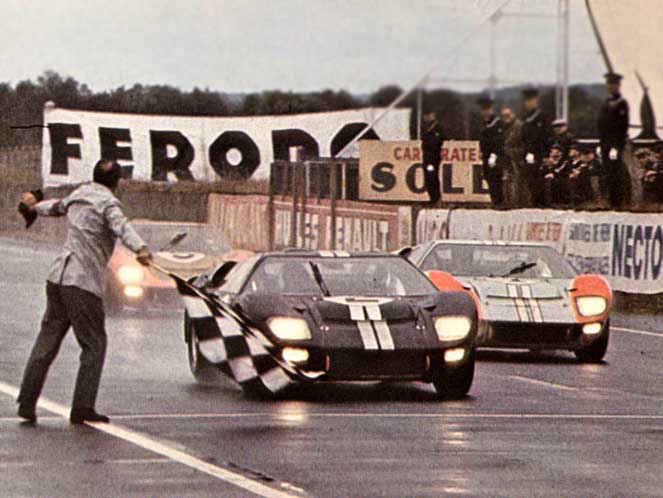 At the ’66 Le Mans Ford applied for 15 starting places and was awarded with eight. All eight cars were the new MkII 7 litre evolution of the GT40 with experienced drivers like Amon, McLaren and Bucknum at the wheel. The race was started by Henry Ford II himself who obviously expected his cars to take the top positions. 24 Hours later, only three of the eight cars crossed the finish line together, but in first, second and third.
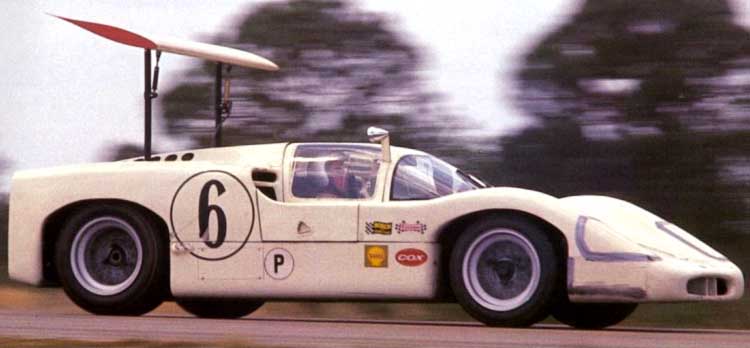 But pushrod V8’s fell short of the 125 bhp/liter the Ferrari engine managed, but with a 100bhp advantage that was of minor concern. The sophisticated Ferrari was beaten by the sheer size of the engines powering the American opposition. Halfway through the race the Shelby entered MkIV’s (Gurney/Foyt and McLaren/Donohue) were comfortably in the lead, the first P4 was in third and the wing on the Chaparral was stuck in the high downforce position, losing 30mph on the Mulsanne straight. When the McLaren/Donohue MkIV suffered a clutch malady, the three surviving P4’s out of the four entered P4’s held second, third and fourth positions. Chaparral’s hopes were dashed by transmission troubles.
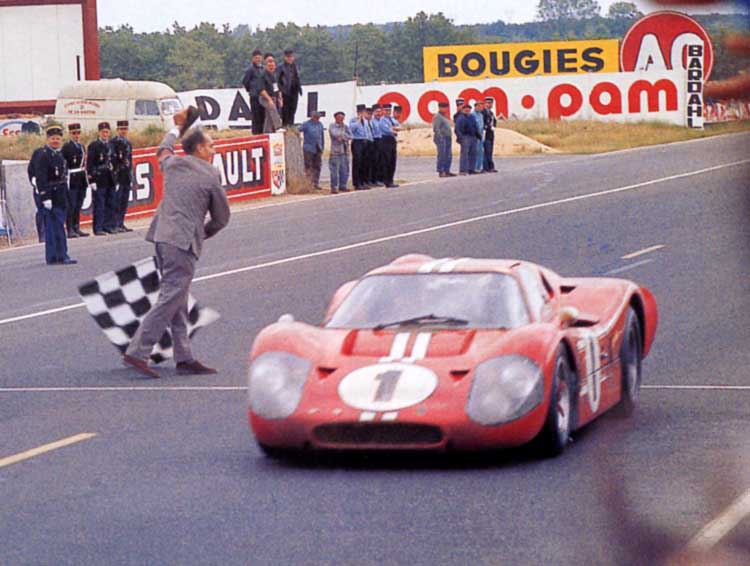 The Gurney/Foyt MkIV won, but the best performance was made by the two surviving P4’s, even though they were outpowered by the Detroit beasts they were only beaten by one and both beat the existing distance record. Ferrari lost but with honour, both surviving P4’s were flogged mercilessly to stay in contention, the first P4 only lost by four laps. Fourth was for the second Shelby MkIV, the clutched-delayed car of McLaren and Donohue.
Both the 1966 and 1967 GT40s were powered by 7 litre engines, which were left obsolete by the 5 litre limit enforced in 1968. This was the maximum for the limited production (25 car minimum) sports car class, the displacement limit for prototypes changed to a mere 3 litre. These rule changes made Ford’s works team lose interest, but some privateers would return to Le Mans with the GT40.
The Gurney/Foyt MkIV won, but the best performance was made by the two surviving P4’s, even though they were outpowered by the Detroit beasts they were only beaten by one and both beat the existing distance record. Ferrari lost but with honour, both surviving P4’s were flogged mercilessly to stay in contention, the first P4 only lost by four laps. Fourth was for the second Shelby MkIV, the clutched-delayed car of McLaren and Donohue.
Both the 1966 and 1967 GT40s were powered by 7 litre engines, which were left obsolete by the 5 litre limit enforced in 1968. This was the maximum for the limited production (25 car minimum) sports car class, the displacement limit for prototypes changed to a mere 3 litre. These rule changes made Ford’s works team lose interest, but some privateers would return to Le Mans with the GT40.
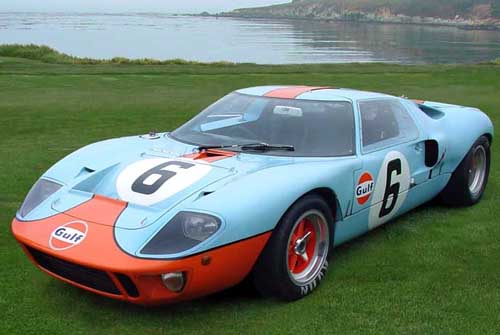
One of these privateers was JW Automotive, founded by John Wyer. As team manager for Aston Martin back in the 1950s Wyer had already secured an overall victory at Le Mans with the DBR1 in 1959. Wyer had also been closely involved with the original GT40 project in 1964.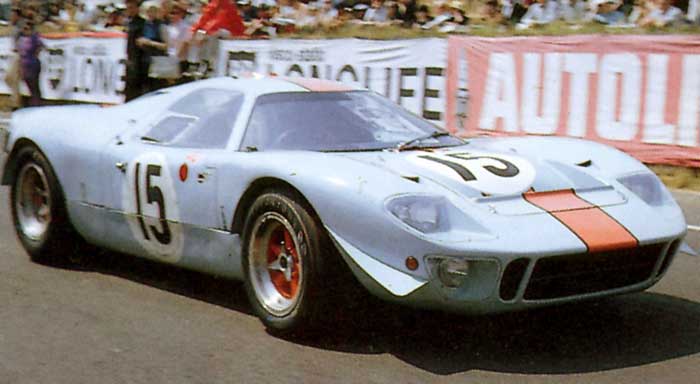 In 1967 JW Automotive had bought up the assets of Ford Advanced Vehicles in the UK, after production of the GT40 had moved to the US. Backed by Gulf Oil, JW Automotive produced the lightest of all versions of the GT40, the Mirage. It incorporated many GT40 parts but featured a narrower and smoother bodywork. Only three of these were built in 1967, leaving them useless for 25 car minimum sportscar class. Of the original 4.7-4.9 litre GT40 well over 25 had been produced, this seemed to be the perfect car to field in 1968.
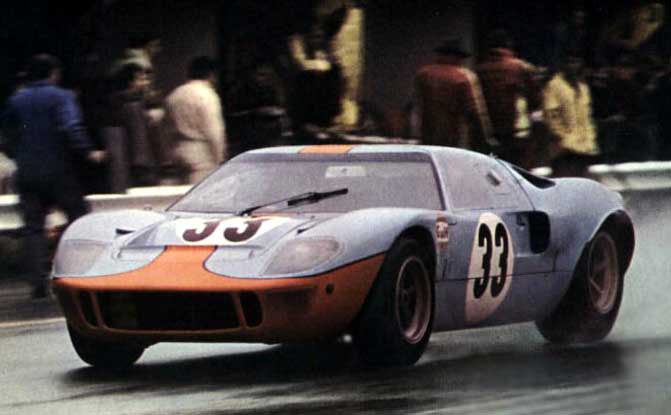 One of the Mirages was converted to Gulf spec. Which included an aluminum roof, carbon-fibre reinforced body panels, a lightweight chassis and an aluminum spare wheel cover. Power came from a 302 cid V8 engine, pumping out a healthy 425 bhp. Allthough the Gulf spec cars had a much smaller engine, they were often capable to copy the lap times the 7 litre GT40s had posted in 1967. Two more cars were completed and added to the JW Automotive team for Le Mans that year, all livered in the now legendary Gulf colors. Most of the GT40s built in 1968 and 1969 were built to Gulf specification.
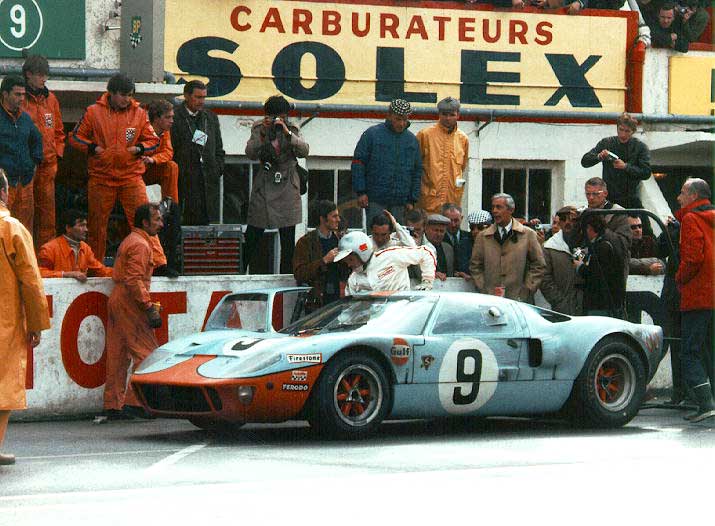 With the Ford works team, Ferrari had withdrawn for the time being to focus on building a 3-litre prototype and a 5 litre production car. The fiercest competition for the Gulf GT40s was expected to come from Porsches new 908 prototype, with Matra and Alpine as outsiders. Jacky Ickx had already boosted moral by dominating the Spa 1000 km in the rain in his GT40. At Le Mans, Ickx wasn’t there because of his accident during the Canadian GP practices. Only one of the three GT40s survived, but the one that did finish, finished on top. A genuine hattrick for the GT40! The winning Gulf GT40 was s/n 1075, piloted by Rodriguez and Bianchi.
Many thought that this was the swansong for the GT40 at Le Mans, with Ferrari back in the action in 1969 and Porsche fielding the quick 908s and the all new 4.5 litre 917s. For JW Automotive 1969 was an in-between year as they were busy building an all new 3 litre engine Mirage prototype to race in 1970. Even though they were outdated and very much outpaced by the competition JW Automotive again fielded the Gulf GT40s at Le Mans, they had proven to be very reliable. Ickx, driving the 1968 winning s/n 1075 GT40, kept his calm and at the end of the race he found himself fighting for the lead with the sole surviving Porsche 908 of Herrmann. 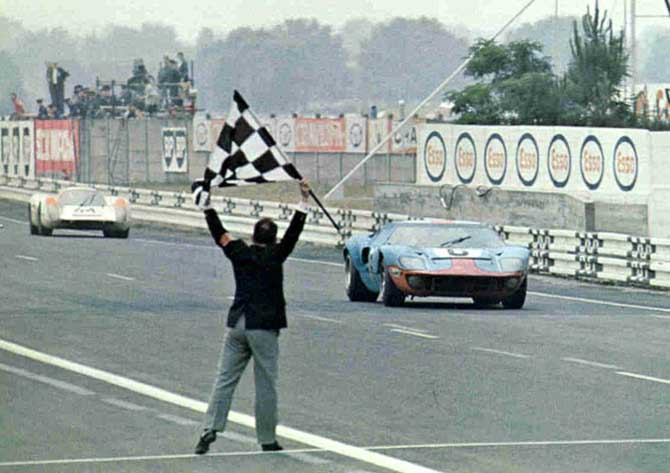 The epic battle between the two led to closest finish in Le Mans history, with only one hundred and twenty metres seperating the two. Against all odds it was Ickx who past the line first, his greatest race and the perfect finale of the GT40 grand career.
That was also the same car that had won the ’68 Le Mans, something else that has not since been done. The Ford GT40 were still the best racing cars in the world.
The epic battle between the two led to closest finish in Le Mans history, with only one hundred and twenty metres seperating the two. Against all odds it was Ickx who past the line first, his greatest race and the perfect finale of the GT40 grand career.
That was also the same car that had won the ’68 Le Mans, something else that has not since been done. The Ford GT40 were still the best racing cars in the world.
 |
 |
 |
 |
 |