In this specification, the minimum weight is 850 kilograms. The gearbox, clutch and suspension are those of the 956, with however an adjustment of the springs and shock absorbers. The capacity of the fuel tank is increased to 120 liters.
For the World Endurance Championship and at Le Mans, Porsche is preparing a version with a 2.65-liter engine, two turbochargers and a water-cooled cylinder head.
The board of directors of motor sport in Paris formulated the regulations for Group C for races in the Sport-Prototype category. This regulation for sports cars will remain valid until 1992. International motor sport was then divided into three sub-categories: Group A (practically series), Group B (major modifications) and Group C (few restrictions, prototypes).
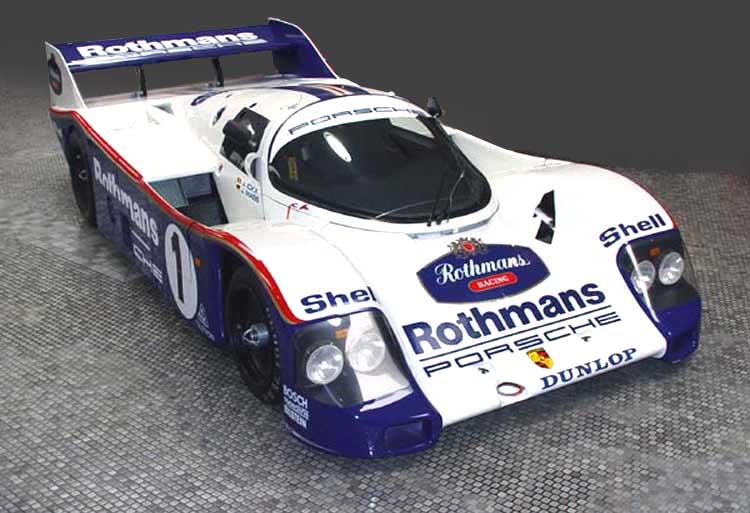 This period of Group C is one of the greatest successes of Porsche in motorsport. With the models 956 (1982-1984) and 962 (1985-1989) – all created under the direction of project manager Norbert Singer, Porsche will win five world championships for manufacturers and drivers. They will win six victories at Le Mans.
Initially, the 1982 season was considered as a year of development for the 956. However, both in the hands of Jacky Ickx and Jochen Mass and those of Derek Bell and Vern Schuppan, the car immediately turns into a winner. Porsche wins the constructors’ world championship and Jacky Ickx wins the first world champion title for sports car drivers. Unforgettable is the final sprint of Jacky towards victory and the world champion title at Brands Hatch, where in the last hour he goes up Riccardo Patrese who was leading by almost a lap.
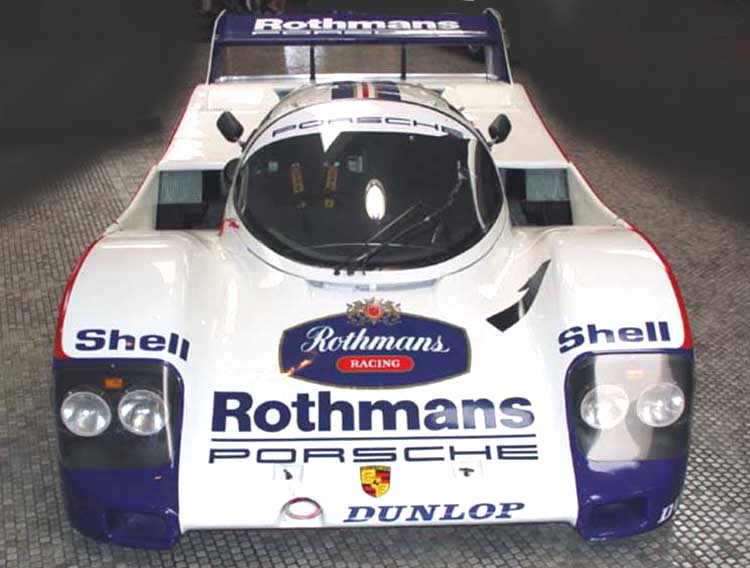 At the 24 hours of Le Mans 1982, the 956 took the first three places. Ickx/Bell (chassis 002) win the victory ahead of Mass/Schuppan (chassis 003) and Haywood/Holbert (chassis 004). During their race to victory at Le Mans, Ickx and Bell broke the distance record they had set the previous year, despite the regulation limiting fuel consumption, and covered 4,899,086 kilometers. Their Porsche 956 will set an average speed of 205 km/h and will have consumed 47.79 liters/100 kilometers. By winning all the categories, with the assistance of the customer teams, Porsche achieves perfect success.
Bob Wollek wins the German motorsport title in a Porsche 936C of the Joest team with three victories ahead of Rolf Stommelen, who – like his French rival – was initially driving a 936, before moving to a Group C car during the season.
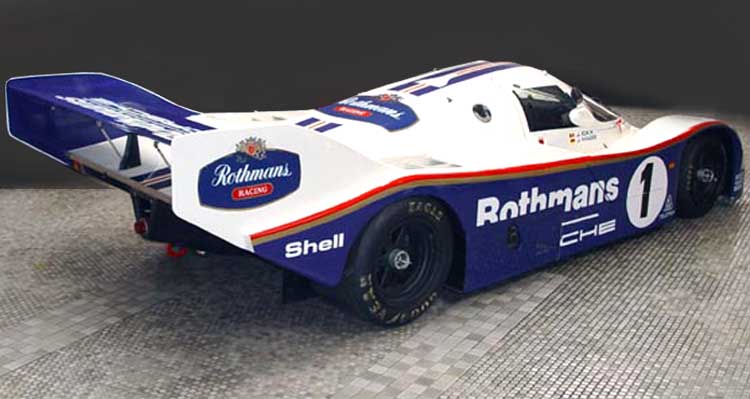 It was in June 1981 that Weissach received the green light to create a two-seater racing car compliant with the regulations of Group C. In August, Norbert Singer worked on the first model at scale 1:5 in the wind tunnel. On 27 March 1982, Jürgen Barth took the wheel of the car with chassis 001 and made his first laps at the Weissach circuit.
The regulation that limits fuel consumption and ground effect being a determining factor in the design of the car: aerodynamics takes on increased importance. Thanks to the profile of the underside of its hull, the 956 generates a powerful aerodynamic ground effect, without the use of sliding skirts used in F1 but banned in Group C. As a result, the 956 reaches turning speeds never reached by sports cars.
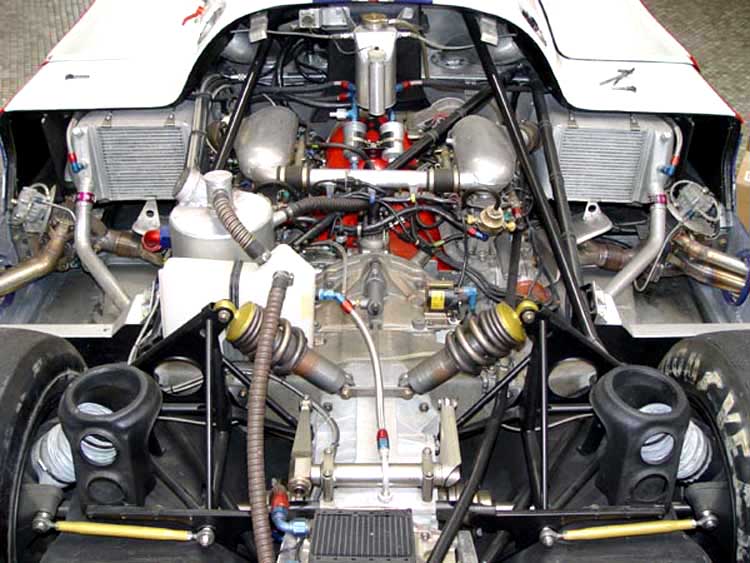
The regulation also defines the proportion between the total length of the car in relation to its wheelbase, this in order to avoid excessive long queues. To take this factor into account, Porsche finally chose a wheelbase measuring 265 cm for the 956 (against 230 cm for the 917), the longest wheelbase of all racing Porsches at the time.
The 956 features an aluminum monocoque chassis. It was the first time this style of construction was used by Porsche. All suspension components – of which only the lower triangles are in the air flow – were designed to withstand the high stresses due to ground effect. The five-speed gearbox, fully synchronized, was completely new. For the engine, Porsche first kept the solution that had proven itself. The year before, the 936’s 2.65-litre twin-turbo six-cylinder boxer won at Le Mans. With about 635 HP (at 8,000 rpm) and a regulated weight of 800 kilos, the weight/power ratio was 1.35 kilos per horsepower.
28 examples of the 956 were built until 1984.
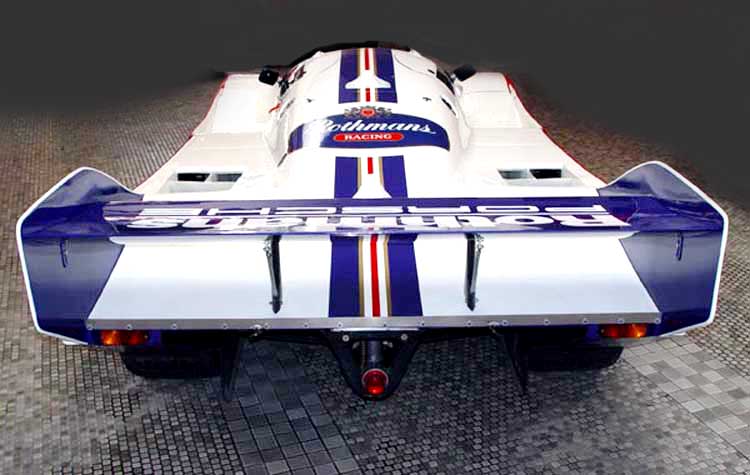 The potential of the 956 increases in 1983. Porsche wins the World Endurance Championship again, Jacky Ickx wins his second consecutive world champion title. Twelve 956 are delivered to private customers. Bob Wollek wins not only the European Endurance Championship with the Joest Porsche team, but also the victory in the German Championship, for which the Frenchman is once again rewarded by the Porsche Cup as the most successful private driver. In Japan, the Australian Vern Schuppan wins the Group C Driver’s Championship with his 956. The manufacturers’ title goes to Porsche.
During the 24 hours of Le Mans, Hurley Haywood, Al Holbert and Vern Schuppan win over factory N°3’s 956 ahead of their teammates Jacky Ickx and Derek Bell. While the new factory driver Stefan Bellof, associated with Jochen Mass, abandons with the third factory 956 following engine problems. The customer teams complete the success of the German brand: nine Porsche appear in the first ten places!!! Only the ninth place went to Peter Sauber’s BMW team.
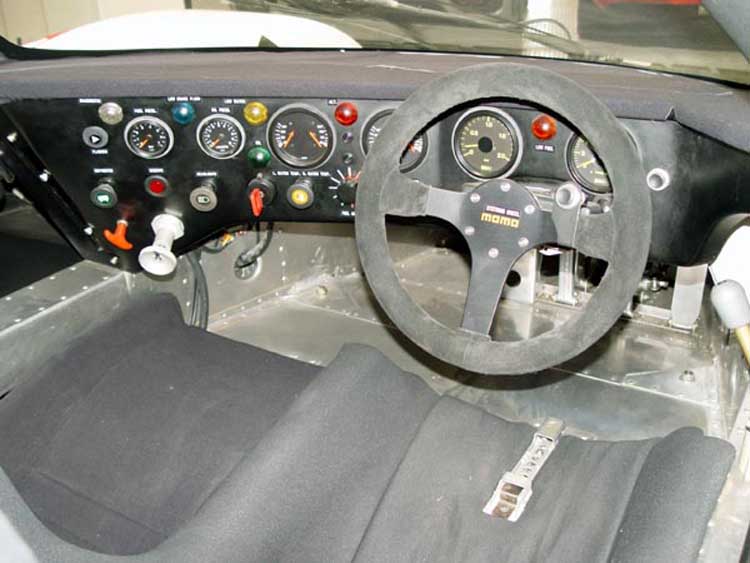 At the Geneva Motor Show, in April 1984, the new Formula 1 engine is presented: the TAG Turbo – made by Porsche (internal code: TTE P01 V6). The V6 with an 80 degree angle, developed by Hans Mezger, is exceptionally light and compact. With all the accessories, the engine weighs 150 kilos. Porsche announces that the engine built for the McLaren team develops about 600 hp between 10,000 and 11,500 rpm. Initial testing in the 956 takes place at the Porsche test track in Weissach. While Porsche continues the development of the engine, the FIA, the International Motor Sport Federation, announces: from 1984, only 510 liters of fuel are authorized for a race of 1,000 kilometers instead of the 600 liters previously authorized. Porsche introduces electronic injection, increases compression to 8.5 and significantly improves operation. The factory – as well as the customers – is ready for the following year. At that moment, no one can know that the FIA will come back to this point for 1984, causing a scandal.
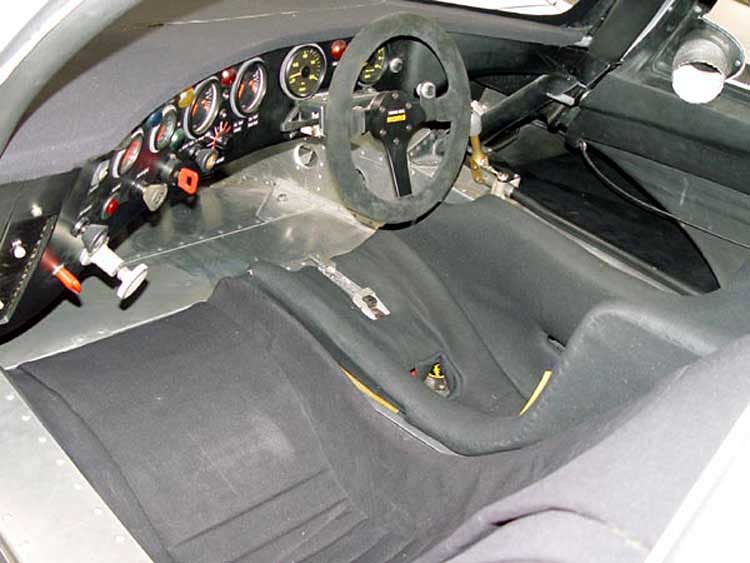 The 962 is initially created under the direction of Norbert Singer for Porsche customers in the United States. It is intended for the IMSA series. The 956 serve as a base. IMSA regulation states that pilots’ feet cannot be beyond the axis of the car’s front axle. As a result, Singer increases the wheelbase to 2.77 meters, resulting in modifications of the monocoque and also reducing the front overhang to not increase the total length. The aerodynamics are modified accordingly. A 2,869-liter twin-valve engine with only one turbo proves to be the best option.
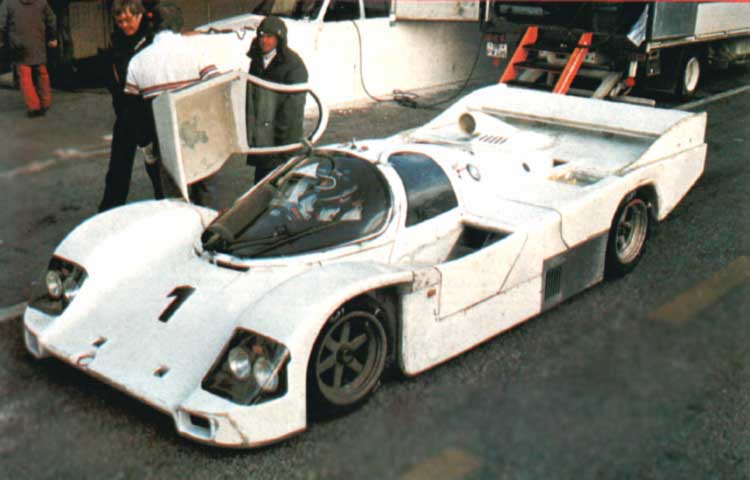
The green light for the 962 was given in mid-October 1983. On 17 October, sketches began for the new monocoque. On December 23, the monocoque is ready, the first test engine is adapted. On January 24, the first 962 is ready to roll and the next day the tests begin at the Paul Ricard circuit. In the evening, 450 kilometers at running speed were covered. On January 27, 1984 the first 962-001 leaves Stuttgart for Florida where it makes an honorable debut by achieving pole position.
In the following years, Porsche built 91 copies of the 962. During the following decade, the 962 became the most successful sports car in history with 54 victories, including 40 between 1985 and 1987.