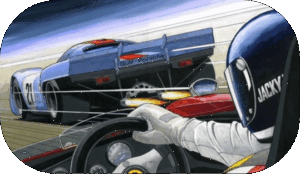
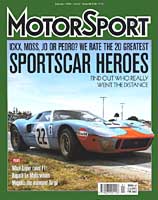
 I was the guest of Jacky Ickx and when we met, he gave me proudly the January issue of MOTOR SPORT, the famous and serious British magazine which published the results of the greatest sportscar driver top 20. I had heard that Jacky was nominated as the greatest sportscar driver ever but I could not find the magazine in my area. I was the guest of Jacky Ickx and when we met, he gave me proudly the January issue of MOTOR SPORT, the famous and serious British magazine which published the results of the greatest sportscar driver top 20. I had heard that Jacky was nominated as the greatest sportscar driver ever but I could not find the magazine in my area.
Jacky is very proud of this title and I’m publishing here the part of the article related to Jacky Ickx, mostly for the people that are not able to find this magazine in their favorite shop. Next month, MOTOR SPORT will publish an article about the F1 career of Jacky Ickx.
| | Tim Scott asked the experts to make their selections from the world sportscar series of 1953-92 – sorry Tom Kristensen – and here are the results of their deliberations. | | 20 | Klaus Ludwig | 10 | Henri Pescarolo | | 19 | Martin Brundle | 9 | Bob Wollek | | 18 | John Surtees | 8 | Han Stuck Jr | | 17 | Tony Brooks | 7 | Olivier Gendebien | | 16 | Mario Andretti | 6 | Phil Hill | | 15 | Juan Manuel Fangio | 5 | Jo Siffert | | 14 | Vic Elford | 4 | Derek Bell | | 13 | Brian Redman | 3 | Pedro Rodriguez | | 12 | Stefan Bellof | 2 | Stirling Moss | | 11 | Jochen Mass | 1 | JACKY ICKX |
| | The Jury was: Rob Aherne, Simon Arron, Jaimes Baker, Jürgen Barth, John Blunsden, David Burgess-Wise, Adriano Cimarosti, Mike Cotton, Hugh Chamberlain, Eric Dymock, Paul Fearnley, Laurence Foster, Andrew Frankel, Graham Gauld, Maurice Hamilton, Peter Higham, Henry Hope-Frost, John Horsman, Mark Hughes, Karl Ludvigsen, David Malsher, Peter Morgan, Dave Price, Rainer Schlegelmilch, Quentin Spurring, Roger Stansfield, Steve Sutcliffe, Simon Taylor, Johnny Tipler, lan Titchmarsh, Jeremy Walton, Gary Watkins, Janos Wimpffen & Eoin Young. | | WHEN THE VOTES WERE COUNTED, THERE WAS A CLEAR NUMBER ONE: FOR 20 YEARS JACKY ICXX WAS THE BENCHMARK FOR ALL SPORTSCAR RACERS. ADAM COOPER EXPLAINS. | 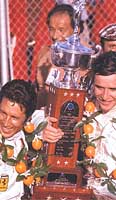 There was only ever going to be one winner of our poll to find the greatest-ever sportscar racer. There were many other claimants, most notably Stirling Moss, but no-one has a CV to match that of Jacques Bernard Ickx. There was only ever going to be one winner of our poll to find the greatest-ever sportscar racer. There were many other claimants, most notably Stirling Moss, but no-one has a CV to match that of Jacques Bernard Ickx.
The ace Belgian won 37 world championship sportscar events between 1967 and ’85, along with three Le Mans 24 Hours triumphs when it did not count towards a championship. In all, of course, he scored a record six victories at La Sarthe, the race that matters more than any other. In recent times Tom Kristensen has nearly matched that, and Ickx himself is sure the Dane has time to surpass his total. However, Jacky’s Le Mans feats were achieved at a time when cars were much more fragile than they are now, and having the quickest package was no guarantee of success. He led on several occasions that he did not win, and it’s also worth remembering that, while at his peak, he did not even contest the race in 1968, ’71-72, 74 and ’84, years in which he could so easily have extended his record. | | “I’m very grateful to MOTOR SPORT for its choice,” he says with genuine appreciation. “Honestly, though, after being selected as the best long distance racing driver, my first reaction is to share the accolade. I am extremely humble about my results and statistics. Without the base of the pyramid – all the mechanics, the engineers and so on – there is no chance for a driver to achieve. This honour has to be shared with all those people and, of course, my friends : Derek Bell, Jochen Mass, Mario Andretti and Brian Redman. We were all sitting behind the same wheel, and were all supported by the anonymous passion of the people who made up the team.“ | | Of course, Ickx is right to remind us that in endurance racing – perhaps more so than any other branch of motorsport – you win and lose as a team. But when he was around you could be sure that everyone else lifted their game to match his. His Formula One career may have run out of steam after the 1974 Race of Champions win with Lotus, but in sportscars he was the master for another decade. He was quick and consistent everywhere, but he especially shone at the old Nürburgring, the old Spa, and anywhere when it rained. And he very rarely made mistakes. | | Ickx’s first experience of endurance driving came when he was just 18, in the 1963 Tour de France in a BMW 700S. Early saloon outings in the Spa 24 Hours and Marathon de la Route gave the precocious teenager further valuable lessons in how to combine speed with consistency. | His first proper sportscar outing came in February 1966, when he’d just turned 21 : “I was taken by Equipe National Belge to Daytona to drive a Ferrari 250LM in the 24 Hours. That was the start, really.” He was to be disappointed by an early retirement.
That year he was really beginning to make a name for himself in Formula Two, and this helped him earn a drive in an Essex Wire Ford GT40 at Le Mans. Alas, it retired during the night with engine failure. | | “CAN YOU IMAGINE, AT 21, BEING A PART OF THE GREATEST RACE? IT WAS UNEXPECTED, A KIND OF DREAM” | 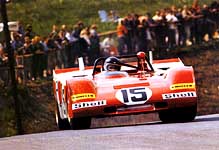 It was not an auspicious start to his career at the Sarthe circuit, but Jacky enjoyed it: “Can you imagine, at 21, being a part of the greatest race? It was unexpected, a kind of dream. If you speak to anyone in the street who isn’t an expert in motor racing, they will still know Le Mans.“ It was not an auspicious start to his career at the Sarthe circuit, but Jacky enjoyed it: “Can you imagine, at 21, being a part of the greatest race? It was unexpected, a kind of dream. If you speak to anyone in the street who isn’t an expert in motor racing, they will still know Le Mans.“
The Essex Wire operation was run by John Wyer and David Yorke, who clearly spotted something special in the youngster. The following year Jacky landed a regular drive in Wyer’s Gulf-backed Mirage M1, a development of the GT40. The Ickx sportscar story really got into gear in May, when he carried American veteran Dick Thompson to a memorable win in a soaking wet Spa 1000Km. Unsurprisingly, he became a favourite of both Wyer and Yorke, bolstering his reputation with some significant non- championship victories for JWA, including one at Kyalami with team debutant Brian Redman. For the 1968 season, Wyer put the duo together full- time in a GT40. They suffered several frustrating retirements, but won at Brands Hatch and Spa, while Jacky also triumphed at Watkins Glen with countryman Lucien Bianchi. However, a bad crash in the Canadian Grand Prix forced him to miss September’s Le Mans, when ‘his’ car won in the hands of Bianchi and Pedro Rodriguez. | Ickx made amends at La Sarthe the following year. Following on from their Sebring success, he and Jackie Oliver took the same GT40 chassis, 1075, to the most memorable of all Le Mans wins. Ickx’s ‘walk’ protest at the start and the close finish made Le Mans ’69 the stuff of legend.
“It is the famous one for the public. It was the perfect script – the guy who starts last, finishes first! Well before the end, as I was young, I was convinced I was going to win it. It was a good race because, for the final three hours, the Porsche and us were never separated by more than 50 meters.“ | 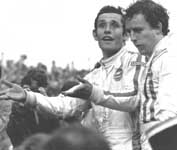 Much of ’69 was lost to the unreliability of the quick-but-fragile Mirage M3. However, Ickx has fond memories of the JWA days : “It was magnificent. The spirit was good, and the team was perfect. John and David were like the fingers of a hand, and they made my career. I was very fast at that time, I think. I was extremely young compared to the average driver: I had no fear and I could stay on the road. I had the right philosophy for it and I had the right partners. The only unfortunate thing is that you don’t appreciate these good things as much as you should at the time.“ Much of ’69 was lost to the unreliability of the quick-but-fragile Mirage M3. However, Ickx has fond memories of the JWA days : “It was magnificent. The spirit was good, and the team was perfect. John and David were like the fingers of a hand, and they made my career. I was very fast at that time, I think. I was extremely young compared to the average driver: I had no fear and I could stay on the road. I had the right philosophy for it and I had the right partners. The only unfortunate thing is that you don’t appreciate these good things as much as you should at the time.“
Ickx signed a Ferrari deal for 1970 that included sportscars as well as Fl, while Wyer became the main opposition by switching from Ford to Porsche. The works 512S was outclassed by the army of 917s; second at Spa with John Surtees was a rare highlight. | | In ’71, Jacky often flew in the new 3 litre 312PB but the Porsches still won. But when the new rules for 1972 ousted the 917s, Ferrari was dominant. Ickx won on four occasions with Mario Andretti, and once apiece with Clay Regazzoni and Redman. Had there been a drivers’ world championship, he would have walked it. | | “It was an unbelievable racing toy,” says Ickx of the later 312PB, perhaps the closest thing ever to a two-seat F1 car. “It was a totally unbeatable car, and Mario was very good; we shared a common outlook and we were very comfortable together.“ | | In 1973, Ferrari reunited Ickx with Redman for a full season, but as Matra gained the upper hand, the pair were restricted to just two wins. Ferrari’s sportscar programme then ground to a halt and, having signed for Lotus in F1, Ickx spent ’74 as a sportscar freelance : he had a few outings for Alfa Romeo, and drove Wyer’s latest Mirage at Paul Ricard (sharing with Derek Bell for the first time). But the high point was victory in the Spa 1000Km on a one-off outing with Matra, alongside Jean- Pierre Jarier; Jacky also took pole and set fastest lap. “It was the best sportscar of the time. Matra produced an unbelievable piece of engineering.“ | | By the following year, Le Mans had dropped out of the world championship, but Ickx teamed up with Bell and took the Mirage to his second win. A new chapter in Ickx’s career began when he joined Porsche in 1976, establishing a relationship that would endure for the remaining 10 seasons of his career. This period was a disjointed, schizophrenic one for the world championship, with Porsche electing to tackle selected ‘Makes’ rounds with its superb new 935, and ‘Sportscar’ events with the 936. It was at this time that Ickx forged the formidable partnership with Jochen Mass that would become the most successful in world championship history. Over the next three years alone, they won 10 races in the two categories – while Jacky also scored his third Le Mans victory, in ’76, with the 936, this time with Gijs van Lennep. | | Le Mans 1977, however, stands as Ickx’s greatest race. Partnered by fellow three-time winner Henri Pescarolo, their 936 failed early on. Jacky was then switched across to join Jürgen Barth and Hurley Haywood, whose delayed sister car was far from the lead. In 41st, to be exact. With nothing to lose, Ickx threw caution to the wind. He lapped at impossible speeds during the wet and foggy night, running two stints of nearly four hours apiece, with just a mandatory short break in between. It was his Nürburgring ’57; a race where even a great driver found something extra within himself. | | “It was fantastic through the night, like a dream,” he explains. “That’s why I say it was the best race of my life, because it was something I can hardly explain. You are so sure, so confident, so efficient, so concentrated and so awake that you are reacting so quickly. That happens only once in your life, I think. I never had the impression I was taking risks – I was just driving flat out. The fun came because we didn’t have to be conservative anymore.“ | Even more than 1969, that fourth victory forged the Ickx-Le Mans legend. From that point on, when ever he lined up in a Porsche, people would expect a little magic. He would finish second in ’78, and retire, after setting the pace, the following year.
By 1979, Ickx’s F1 career had stumbled to a halt following a troubled half-season at Ligier. He did, however, win the Can-Am title for Carl Haas over in the United States. But after securing the crown at the Riverside finale, he announced his retirement. He was just 34. | | However, Porsche persuaded him back into action for one weekend in the following two years – the lure of Le Mans remained. Frustrating delays demoted him to second with Reinhold Joest’s ersatz 936 in 1980, but in ’81 things went right with the factory team and he scored his fifth win – his second with Bell. This result moved him ahead of countryman Olivier Gendebien in the history books. | Jacky’s loyalty to Porsche paid off when the new Group C rules came along in 1982. By now there was at last a drivers’ title to chase, and a revitalised Ickx welcomed the chance of a full-time return. The new 956 was a great car, although Jacky had little time for the fuel consumption rules which proved so unpopular in the early days : “It was a Porsche, so you can imagine how good it was. But the consumption aspect went against racing. It became more of an economy run than anything, and it was very frustrating for the drivers.“
He won at Le Mans for the sixth time, again with Bell, and went into the drivers’ title-decider at Brands Hatch having to beat Lancia’s F1 aces, Riccardo Patrese and Michele Alboreto. | “I was very young at the time. I had limited experience, but I had the right philosophy”
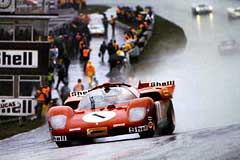 I did not witness any of Ickx’s legendary Le Mans successes first hand, but I went to that race in Kent, hoping to see something special. I was not disappointed. It was a thrilling wet/dry affair, bisected by a stoppage after the works Ford C100s had taken each other out – and we saw the very best of Jacky Ickx. Sensational in the earlier rain, he found himself chasing Patrese’s team-mate Teo Fabi home in the closing laps. Darkness was falling, rain clouds loomed, and with his headlights spooking anyone who got in his way, Jacky relentlessly reeled in the hapless Fabi. Helped by a small time-advantage from before the red flag, he made it. He was a world champion at last. I did not witness any of Ickx’s legendary Le Mans successes first hand, but I went to that race in Kent, hoping to see something special. I was not disappointed. It was a thrilling wet/dry affair, bisected by a stoppage after the works Ford C100s had taken each other out – and we saw the very best of Jacky Ickx. Sensational in the earlier rain, he found himself chasing Patrese’s team-mate Teo Fabi home in the closing laps. Darkness was falling, rain clouds loomed, and with his headlights spooking anyone who got in his way, Jacky relentlessly reeled in the hapless Fabi. Helped by a small time-advantage from before the red flag, he made it. He was a world champion at last. | | Ickx won more races and his second title in 1983, but by ’84 Porsche had a new star in Stefan Bellof. The German won the sportscar crown while also dazzling the F1 world under the wing of Ken Tyrrell, the very man who’d given Jacky his big break. Ickx was well aware that the torch was being passed to the fearless youngster: “He was quick and he was the perfect team-mate for Derek. They were winning almost every race.“ | | For 1985, Bellof switched to the Brun customer team, and was now even keener to prove he was the best against the factory cars. On Ickx’s home ground at Spa, he made a foolhardy lunge inside his former team-mate on the approach to Eau Rouge. I watched from the pitlane as the pair touched and spun in unison; Ickx’s car skated along the barrier rear first, but Bellof’s struck head-on with fatal results. Jacky was very shaken by the biggest accident he’d had in years, and any thoughts he’d already had about it being time to stop were brought sharply into focus. | | “Although I didn’t feel any responsibility, how can you forget something like that ? It was terrible. It was a warning, and I was also the right age to retire. Everybody knows it has to end; you have to admit it, but you don’t know exactly when. I liked the fact that I was able to say, ‘That’s it, I’ll go away’.“ | | He went out in style, winning his final race at Malaysia’s Shah Alam with Mass. Eighteen years had passed since that first Spa win, and yet he was still only 40: “It was a necessity to get back in the car [for Shah Alam]. That was the end of my deal with Porsche. I knew it was the last race – and I won. It was a positive way to end a long career.“ | | Ickx is modest about his achievements : “I was often in the right team, in the right car, with the right partner. I was very young at the time, and I was the opposite of what you expect an expert long-distance driver to be, because you need experience. But I think I had the right philosophy, and my co-drivers had the same philosophy. We didn’t have to speak about it, we just knew. When one of them brought a car into the pits, I knew it would be in good shape – and they knew I’d bring it back in good shape, too. With guys like that, the chances of finishing a race well were very high.“ |
Written by ADAM COOPER – MOTOR SPORT
Originally published on 2004-01-22 |